Building a Tamil Coreference Resolution System: Zero-Shot Contextual Span Modeling with MuRIL for Low-Resource NLP

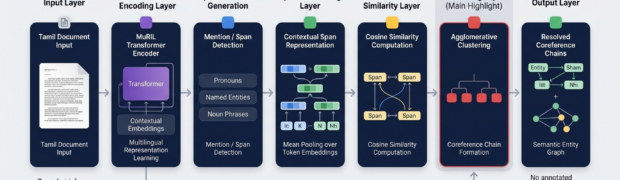
Building a Tamil Coreference Resolution System: Zero-Shot Contextual Span Modeling with MuRIL for Low-Resource NLP
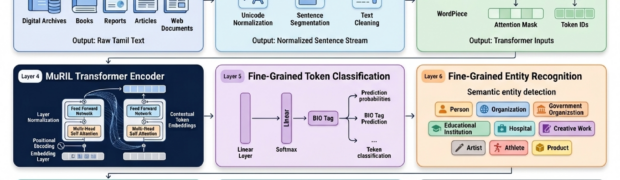
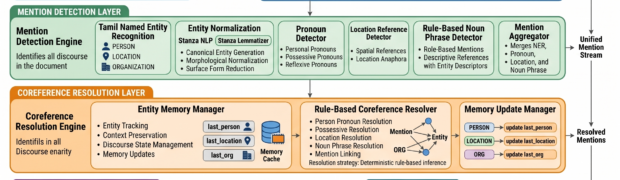
Coreference Resolution (CR) is one of the most important tasks in Natural Language Processing (NLP). It focuses on identifying whether multiple expressions within a document refer to the same real-world entity. Resolving these semantic references is critical for document-level understanding and directly impacts downstream NLP systems such as: Information Extraction Knowledge Graph Construction Question Answering ...

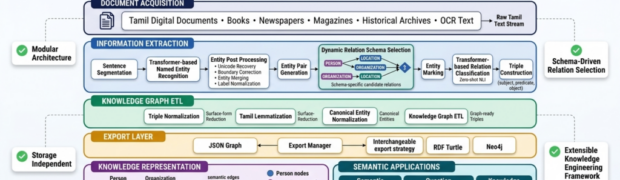
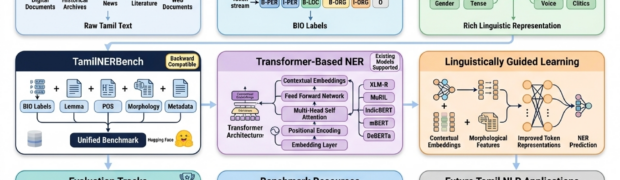
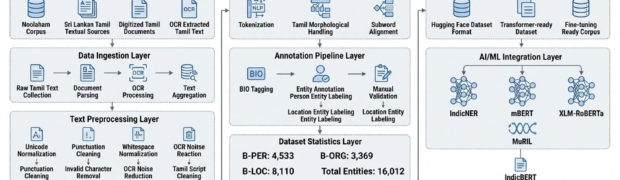
Building a Morphology-Aware Tamil NER Pipeline: From Transformer Extraction to Canonical Entity Resolution

Building a Morphology-Aware Tamil NER Pipeline: From Transformer Extraction to Canonical Entity Resolution
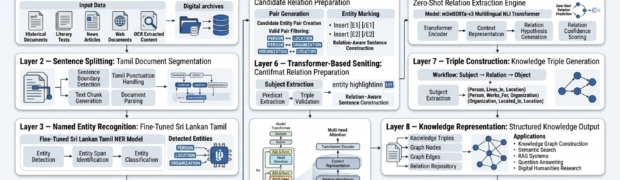
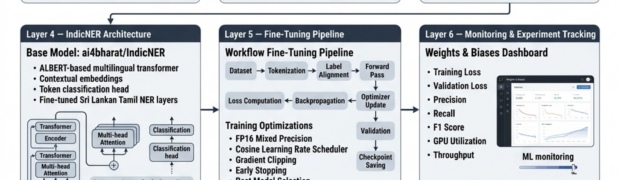
Named Entity Recognition (NER) is a foundational layer in modern NLP systems. It directly impacts downstream applications such as search, indexing, knowledge graph construction, entity linking, and Retrieval-Augmented Generation (RAG). However, for Tamil and other morphologically rich languages, entity extraction alone is insufficient. The larger challenge lies in canonicalizing entity variants into stable root forms ...

Building a Tamil Keyword Extraction Pipeline: From Statistical Methods to Embedding-Based Semantic Extraction

Building a Tamil Keyword Extraction Pipeline: From Statistical Methods to Embedding-Based Semantic Extraction
Keyword extraction is a foundational component in modern NLP systems. It directly impacts search quality, indexing efficiency, document summarization, topic discovery, and Retrieval-Augmented Generation (RAG) pipelines. However, for low-resource languages such as Tamil, keyword extraction introduces several challenges that extend beyond simply applying existing algorithms. In practice, achieving reliable extraction required careful system-level engineering involving ...

Designing an Efficient Reranking Layer: Multilingual Cross-Encoder Optimization for Tamil–English RAG

Designing an Efficient Reranking Layer: Multilingual Cross-Encoder Optimization for Tamil–English RAG
Retrieval-Augmented Generation (RAG) systems are fundamentally dependent on retrieval quality. In multilingual environments, dense retrieval can surface relevant passages, but retrieval alone is often insufficient for producing reliable downstream responses. In practice, not all retrieved chunks are equally relevant. Passing large sets of loosely related candidates directly into the LLM increases token usage, introduces noisy ...

Document AI in Production: Cost, Language, and Infrastructure Constraints

Document AI in Production: Cost, Language, and Infrastructure Constraints
Document extraction is often straightforward at demo scale. However, under real production conditions—large document volumes, multilingual corpora, and limited hardware resources—the problem becomes significantly more complex. Modern Document AI systems must optimize not only for accuracy, but also for scalability, latency, infrastructure cost, and multilingual robustness. Constraint 1: Cost (Operational Expenditure) Cloud-based OCR and parsing ...

Designing a Bilingual RAG System: Cross-Lingual Dense Retrieval for Tamil–English

Designing a Bilingual RAG System: Cross-Lingual Dense Retrieval for Tamil–English
Retrieval-Augmented Generation (RAG) systems are highly dependent on retrieval quality. In multilingual environments, the problem becomes significantly more complex because the retrieval layer must operate across languages while maintaining semantic consistency. For Tamil–English systems, one of the key challenges is cross-lingual retrieval — enabling a query in Tamil to retrieve semantically relevant Tamil and English ...