
Introduction
Named Entity Recognition (NER) is one of the fundamental sequence labeling tasks in Natural Language Processing (NLP), where each token in a sentence is assigned a semantic label representing real-world entities such as persons, organizations, locations, products, events, and creative works.
NER serves as a foundational component for numerous downstream AI systems, including:
- Information Extraction
- Knowledge Graph Construction
- Semantic Search
- Entity Linking
- Question Answering
- Retrieval-Augmented Generation (RAG)
- Digital Document Intelligence
Over the past decade, transformer-based language models have significantly advanced NER performance by learning contextual token representations rather than relying on handcrafted linguistic features. However, most publicly available Tamil NER systems remain coarse-grained, identifying only three primary entity categories—PERSON, LOCATION, and ORGANIZATION. While this level of semantic abstraction is adequate for many applications, it becomes insufficient for large-scale document intelligence systems that require more expressive semantic representations.
In our earlier work at CTNLPR, we addressed this problem by fine-tuning IndicNER for Sri Lankan Tamil Named Entity Recognition, focusing on adapting the model to recognize coarse-grained entity categories within Sri Lankan Tamil documents.
This work explores a different research direction.
Rather than adapting a model to a new domain, our objective is to investigate whether a multilingual transformer can learn a fine-grained semantic entity taxonomy, enabling substantially richer entity representations for Tamil document understanding.
To achieve this, we fine-tuned Google’s MuRIL (Multilingual Representations for Indian Languages) on the SampurNER Fine-Grained Tamil NER dataset, formulating the task as a supervised token-level sequence labeling problem over an expanded semantic ontology. MuRIL was specifically developed for Indian languages using multilingual pretraining augmented with translated and transliterated corpora, making it particularly suitable for low-resource language representation learning.
Why Fine-Grained Named Entity Recognition?
Conventional Tamil NER systems assign entities to a limited number of coarse semantic categories:
- PERSON
- LOCATION
- ORGANIZATION
Although these categories capture the existence of entities, they discard much of the semantic information required by downstream reasoning systems.
For example, all of the following may be classified simply as ORGANIZATION:
- Government Ministry
- University
- Hospital
- Bank
- Software Company
- Research Institute
Similarly, all individuals are typically labeled as PERSON, regardless of whether they represent:
- Politicians
- Athletes
- Writers
- Scholars
- Artists
- Scientists
Fine-Grained Named Entity Recognition (FgNER) addresses this limitation by reformulating NER as a high-cardinality semantic classification problem, where entity mentions are mapped to a substantially richer ontology instead of a small set of generic classes.
Examples of fine-grained entity types include:
- Government Organizations
- Educational Institutions
- Hospitals
- Buildings
- Products
- Events
- Diseases
- Creative Works
- Athletes
- Artists
- Writers
- Scholars
- Biological Entities
This richer semantic representation significantly improves the quality of downstream information extraction and knowledge representation.
Why MuRIL?
Selecting an appropriate encoder is particularly important for low-resource languages.
General multilingual transformers often allocate only a small fraction of their vocabulary and training corpus to Indian languages, limiting their ability to model complex linguistic phenomena.
MuRIL was specifically designed to overcome this limitation.
Unlike generic multilingual models, MuRIL was pretrained using:
- Large-scale Indian language corpora
- Parallel translated sentence pairs
- Transliterated document pairs
- Multilingual masked language modeling
These additional supervision signals enable MuRIL to learn stronger contextual representations for Indian languages while improving cross-lingual semantic alignment. (arXiv)
Because Tamil belongs to one of the primary target languages during MuRIL pretraining, it provides an excellent transformer backbone for Fine-Grained Tamil NER.
Problem Formulation
We formulate Fine-Grained Tamil NER as a token-level sequence labeling task.
Given an input sentence
X={x₁,x₂, …, xₙ}
the objective is to predict a BIO label
Y={y₁, y₂, …, yₙ}
where each token is assigned one of the fine-grained semantic entity labels defined by the SampurNER ontology.
During inference, contiguous BIO predictions are decoded into complete entity spans representing semantically meaningful entities.
Model Architecture
The overall architecture follows a standard transformer-based token classification pipeline.
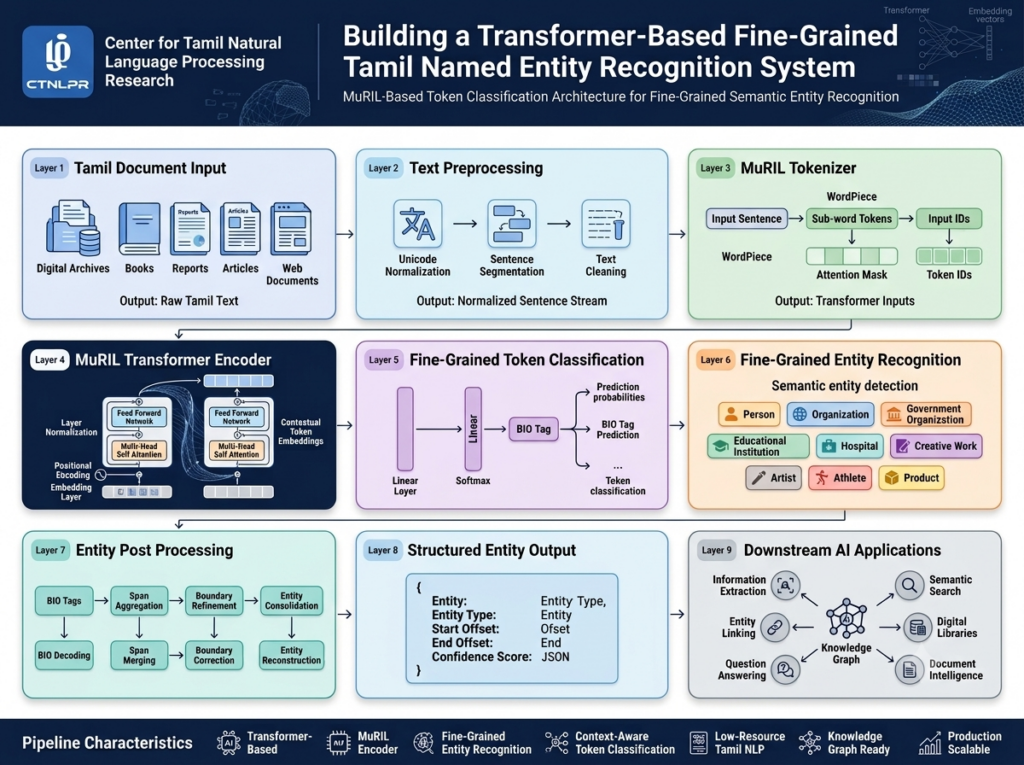
Base Encoder
- Google MuRIL (google/muril-base-cased)
Training Dataset
- SampurNER Tamil Fine-Grained NER Dataset
Fine-Tuning Configuration
- MuRIL tokenizer
- WordPiece tokenization
- BIO tagging
- Token classification objective
- Dynamic sequence padding
- Validation-driven early stopping
- Best checkpoint selection
Rather than modifying the transformer architecture itself, our work specializes MuRIL’s contextual representations for fine-grained semantic entity classification through supervised optimization.
Technical Challenges
1. High-Cardinality Semantic Label Space
Fine-Grained NER dramatically increases the number of semantic classes compared to conventional NER.
Instead of distinguishing only three categories, the model must discriminate among numerous semantically related entity types whose contextual distributions frequently overlap.
This substantially increases classification complexity.
2. Agglutinative Morphology
Tamil is characterized by productive agglutinative morphology.
Entity mentions frequently appear with multiple grammatical suffixes, resulting in large lexical variation while preserving semantic identity.
Consequently, the model must learn contextual semantic representations that remain invariant under morphological transformations.
3. Long Multi-Token Entity Spans
Many Tamil entities—particularly government institutions, educational organizations, hospitals, and administrative bodies—consist of long multi-word expressions.
Boundary identification therefore becomes considerably more challenging.
An incorrect prediction for a single boundary token causes the entire entity span to be classified incorrectly.
4. Fine-Grained Semantic Ambiguity
Several entity categories share highly similar lexical patterns.
For example:
- Educational Institution
- Government Organization
- Public Authority
often contain nearly identical vocabulary.
Successful classification therefore depends on contextual semantic reasoning rather than lexical matching alone.
Model Observations
During empirical evaluation, the fine-tuned MuRIL model demonstrated strong contextual discrimination across multiple fine-grained entity categories.
Particularly encouraging performance was observed for:
- Person
- Organization
- Government Organization
- Educational Institution
- Buildings
- Hospitals
- Products
- Creative Works
The multilingual contextual representations learned during MuRIL pretraining transferred effectively to Fine-Grained Tamil NER after supervised task adaptation, enabling robust semantic classification across a diverse entity ontology.
Applications
Fine-Grained Tamil NER substantially enhances the semantic richness of downstream NLP systems.
Potential applications include:
- Information Extraction
- Entity Linking
- Semantic Search
- Knowledge Graph Population
- Retrieval-Augmented Generation
- Digital Libraries
- Document Intelligence
- Tamil Question Answering
- Large-Scale Archive Processing
Compared to coarse-grained NER, Fine-Grained entity typing provides significantly more informative semantic representations that improve both retrieval quality and structured knowledge construction.
Key Technical Insight
One of the most important observations from this study is that the primary limitation of conventional Tamil NER is not entity detection itself, but semantic granularity.
Accurate identification of an entity as merely PERSON or ORGANIZATION provides limited semantic value for downstream reasoning.
Fine-Grained entity typing preserves domain-specific distinctions that are otherwise collapsed into broad categories, substantially increasing the expressive capacity of structured knowledge representations.
From an information extraction perspective, semantic specificity is often as important as entity recognition accuracy.
Implementation at CTNLPR
At CTNLPR (Center for Tamil Natural Language Processing Research), this Fine-Grained Tamil NER system has been developed as part of our broader multilingual document intelligence ecosystem.
The current implementation provides:
- Transformer-based token classification using MuRIL
- BIO sequence labeling
- Fine-grained semantic entity classification
- High-cardinality entity taxonomy
- Context-aware multilingual representations
- Integration-ready outputs for Information Extraction and Knowledge Graph Construction
Unlike our previous IndicNER-based work, which focused on coarse-grained Sri Lankan Tamil entity recognition, this system emphasizes semantic specialization, enabling richer entity representations for advanced AI applications.
Conclusion
Fine-Grained Named Entity Recognition represents a significant advancement beyond conventional coarse-grained sequence labeling by enabling substantially richer semantic understanding of Tamil text.
Our exploration demonstrates that MuRIL’s multilingual contextual representations can be effectively specialized for high-cardinality semantic entity classification through supervised fine-tuning on a fine-grained Tamil entity ontology.
As Tamil NLP continues to evolve toward document intelligence, semantic retrieval, and knowledge-driven AI systems, Fine-Grained NER will become an increasingly important component for scalable Information Extraction, Knowledge Graph Construction, and Retrieval-Augmented Generation pipelines.
At CTNLPR, this work contributes to the development of semantically enriched Tamil language technologies capable of supporting next-generation multilingual AI systems.