
The rapid advancement of Transformer-based multilingual language models has significantly improved Named Entity Recognition (NER) across many languages. Models such as IndicBERT, MuRIL, XLM-R, mBERT, and more recently Large Language Models (LLMs), have substantially advanced multilingual NLP by learning contextual representations from massive corpora.
Despite these advances, Tamil continues to present unique challenges for Named Entity Recognition due to its rich morphological structure. Unlike English, where grammatical relationships are often expressed through separate words, Tamil encodes substantial grammatical information within individual words through suffixes, case markers, and inflectional morphology. While existing Transformer architectures have demonstrated impressive performance, most current Tamil NER benchmarks evaluate only token-level BIO labels and provide little explicit linguistic supervision.
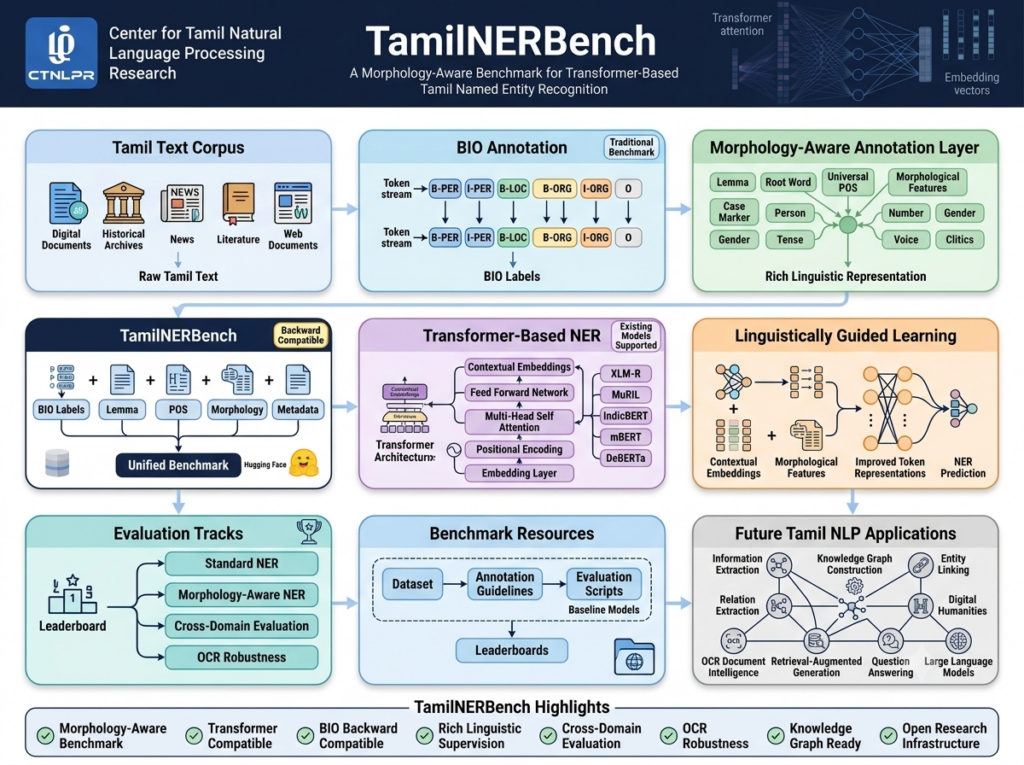
At the Center for Tamil Natural Language Processing Research (CTNLPR), we are exploring TamilNERBench, a next-generation benchmark designed specifically for morphologically rich Tamil. Rather than introducing another standalone dataset, TamilNERBench investigates how benchmark design itself can evolve by integrating explicit linguistic knowledge while remaining fully compatible with modern Transformer-based NER models.
Why Current Tamil NER Benchmarks Are Not Enough
Modern Named Entity Recognition systems are primarily trained using token-level BIO annotations. This approach has become the de facto standard because it is simple, interoperable, and supported across virtually every Transformer-based NLP framework.
However, for morphologically rich languages such as Tamil, BIO labels capture only a small fraction of the linguistic information contained within each word.
For example, the Tamil word
யாழ்ப்பாணத்தில்
contains information about:
- the underlying lemma
- grammatical case
- morphological structure
- part-of-speech
- contextual grammatical function
Yet conventional NER benchmarks typically preserve only a single annotation:
B-LOC
All remaining linguistic information is discarded during training.
As a result, Transformer models must independently infer complex morphological relationships entirely from statistical patterns in the training corpus.
The Vision Behind TamilNERBench
TamilNERBench is built around a simple idea:
Keep the existing BIO tagging scheme—but enrich every token with explicit linguistic annotations.
Instead of replacing current datasets or forcing researchers to redesign existing pipelines, TamilNERBench introduces a parallel linguistic layer containing information such as:
- Lemma
- Root word
- Universal POS tags
- Morphological features
- Grammatical case
- Additional linguistic metadata
Because the original BIO labels remain unchanged, existing NER systems can continue training without any modifications. Researchers interested in traditional token classification can simply ignore the additional annotation layers, while others can explore morphology-aware learning using the richer linguistic information.
This layered design preserves backward compatibility while enabling new directions in Tamil NLP research.
From Dataset to Benchmark
One of the central ideas behind TamilNERBench is the distinction between a dataset and a benchmark.
A dataset provides annotated examples.
A benchmark provides an entire research ecosystem.
TamilNERBench is envisioned not merely as another annotated corpus, but as a standardized benchmarking framework that includes:
- standardized annotation guidelines
- reproducible evaluation protocols
- benchmark tasks
- baseline implementations
- community evaluation tracks
- open research infrastructure
By shifting the focus from data collection to benchmark design, the project aims to provide a common foundation for evaluating future Tamil NER systems.
Morphology-Aware Benchmarking
TamilNERBench extends conventional BIO annotation by introducing explicit linguistic supervision alongside traditional NER labels.
Each annotated token may include:
| Annotation Layer | Description |
|---|---|
| Surface Form | Original token |
| Lemma | Canonical word form |
| Root Word | Morphological root |
| Universal POS | Part-of-Speech |
| Morphological Features | Case, tense, person, number, etc. |
| BIO Label | Named Entity Annotation |
This enriched representation allows researchers to investigate whether explicit morphological information can improve contextual representations learned by multilingual Transformer models.
Rather than treating every inflected word as an independent token, the benchmark preserves relationships between different grammatical forms of the same lexical item.
Research Opportunities
By integrating morphology directly into benchmark design, TamilNERBench opens several new research directions.
Potential areas include:
- morphology-aware Named Entity Recognition
- multi-task Transformer learning
- joint NER and morphological analysis
- OCR-robust entity recognition
- cross-domain evaluation
- representation learning for morphologically rich languages
The benchmark also creates opportunities to study how linguistic supervision influences generalization across unseen entities and noisy document collections.
Supporting the Broader Tamil NLP Ecosystem
Named Entity Recognition serves as the foundation for many higher-level language technologies.
Improvements in entity recognition directly benefit downstream applications including:
- Relation Extraction
- Knowledge Graph Construction
- Entity Linking
- Digital Humanities
- Historical Document Processing
- Retrieval-Augmented Generation (RAG)
- Question Answering
- Tamil Document Intelligence
As part of CTNLPR’s broader research roadmap, TamilNERBench complements ongoing work in OCR, Information Extraction, Knowledge Graph Construction, and multilingual Tamil language technologies.
Looking Ahead
TamilNERBench remains an active research initiative.
Current work focuses on refining the benchmark design, exploring practical annotation schemas, and evaluating how explicit linguistic information can be incorporated into modern Transformer architectures without sacrificing usability.
Future development plans include:
- standardized annotation guidelines
- benchmark evaluation tracks
- OCR-aware benchmark subsets
- cross-domain evaluation protocols
- multilingual benchmark extensions
- public baseline implementations
- community-driven benchmark contributions
By encouraging reproducible evaluation and linguistically informed benchmark design, TamilNERBench aims to provide long-term research infrastructure for Tamil NLP.
Conclusion
The future of Tamil Named Entity Recognition depends not only on larger language models, but also on better benchmark design.
TamilNERBench represents CTNLPR’s vision for a new generation of Tamil NLP benchmarks that combine modern Transformer architectures with the linguistic richness of the Tamil language. By preserving morphology alongside traditional BIO annotations, the benchmark seeks to enable more robust, interpretable, and linguistically grounded Named Entity Recognition systems.
As multilingual AI continues to evolve, benchmark design will play an increasingly important role in shaping future research. Through TamilNERBench, CTNLPR aims to contribute foundational infrastructure that supports researchers, developers, and the wider open-source community in advancing Tamil language technologies for years to come.