
The rapid evolution of transformer-based multilingual NLP systems has significantly improved Named Entity Recognition (NER) performance across many high-resource languages. However, low-resource language variants such as Sri Lankan Tamil still face substantial challenges due to limited domain-specific datasets and linguistic underrepresentation in existing multilingual training corpora.
At CTNLPR (Center for Tamil Natural Language Processing Research), we fine-tuned the IndicNER model specifically for Sri Lankan Tamil using a custom annotated NER corpus.
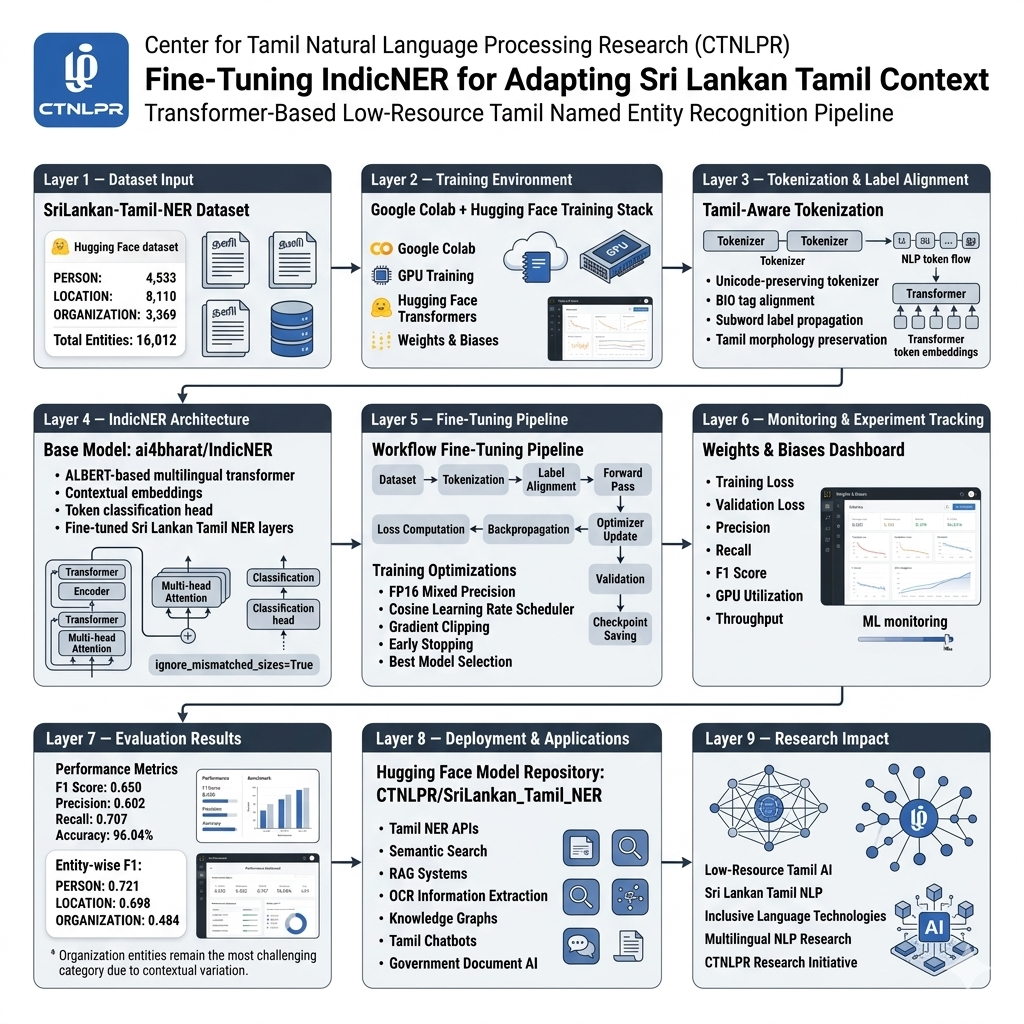
The primary objective of this work was to improve entity recognition performance for Sri Lankan Tamil linguistic patterns, local entities, and morphology-aware contextual variations.
Why Sri Lankan Tamil NER is Challenging
Most multilingual NER systems are trained primarily on:
- general web corpora
- Indian Tamil datasets
- multilingual benchmark datasets
- formal textual sources
When applied to Sri Lankan Tamil, these systems often struggle due to regional linguistic differences and contextual entity variations.
Some of the key challenges include:
- Sri Lankan regional names
- local organization terminology
- morphological suffix complexity
- OCR-induced token inconsistencies
- subword tokenization fragmentation
- contextual ambiguity in entity boundaries
These limitations significantly affect downstream NLP applications such as:
- semantic search
- document intelligence
- knowledge graph generation
- Tamil chatbots
- Retrieval-Augmented Generation (RAG)
- government document processing
Model Fine-Tuning Overview
Base Model
The fine-tuning process was built on top of
IndicNER is a multilingual transformer-based Named Entity Recognition model developed for Indic languages and serves as a strong baseline for Tamil NER tasks.
Training Dataset
The model was fine-tuned using approximately:
Sri Lankan Tamil NER Samples
The dataset was manually curated and annotated under the CTNLPR Tamil NLP research pipeline.
The corpus included annotations for:
| Entity Type | Description |
|---|---|
| PERSON | Human names |
| LOCATION | Geographic entities |
| ORGANIZATION | Institutional entities |
The dataset preparation pipeline incorporated:
- OCR-aware preprocessing
- Unicode normalization
- Tamil-safe tokenization
- BIO tagging
- subword label alignment
- manual annotation validation
Technical Challenges During Fine-Tuning
Fine-tuning multilingual transformer architectures for Tamil requires addressing several language-specific tokenization and alignment problems.
1. Tamil Tokenization Complexity
Tamil is morphologically rich, meaning that suffixes and grammatical structures often alter token boundaries.
Improper tokenization can lead to:
- broken entity spans
- incorrect BIO labels
- fragmented entity predictions
To address this, the pipeline implemented:
- Tamil-safe tokenization
- script-preserving preprocessing
- Unicode normalization
2. Subword Label Alignment
Transformer tokenizers frequently split Tamil words into multiple subword tokens.
Example: யாழ்ப்பாணப் பல்கலைக்கழகம்
may become multiple subword fragments internally. Without correct label alignment:
- entity spans become corrupted
- BIO labels mismatch
- training instability increases
The training pipeline therefore included proper subword label propagation strategies to ensure accurate entity learning.
3. OCR Noise Handling
Tamil OCR systems still generate:
- grapheme inconsistencies
- merged tokens
- invalid Unicode combinations
- punctuation corruption
OCR-aware normalization and cleaning stages were integrated before fine-tuning to reduce noise propagation into the NER model.
Fine-Tuning Configuration
Training Setup
| Component | Value |
|---|---|
| Base Model | IndicNER |
| Language | Sri Lankan Tamil |
| Task | Token Classification |
| Labels | PERSON · LOCATION · ORGANIZATION |
| Architecture | Transformer-based NER |
| Annotation Format | BIO Tagging |
Training Improvements Implemented
Several improvements were introduced during training to better adapt the model for Sri Lankan Tamil.
Key Optimizations
Tamil-safe Tokenization
Preserved Tamil script integrity during preprocessing and tokenization.
Proper Subword Label Alignment
Ensured complete entity learning across fragmented transformer tokens.
Morphology-aware Training
Focused on handling Tamil suffix patterns and contextual entity boundaries.
OCR-aware Preprocessing
Reduced noisy OCR artifacts before training.
Model Evaluation Results
The fine-tuned model achieved the following performance metrics.
Overall Performance
| Metric | Score |
|---|---|
| F1 Score | 0.650 |
| Precision | 0.602 |
| Recall | 0.707 |
| Accuracy | 96.04% |
Entity-wise Performance
| Entity Type | F1 Score |
|---|---|
| PERSON | 0.721 |
| LOCATION | 0.698 |
| ORGANIZATION | 0.484 |
The PERSON and LOCATION categories achieved relatively strong performance, while ORGANIZATION entities remained significantly more challenging.
Inference Examples (Model Predictions)
Example 1
? Input Sentence
“பாரதிதாசன் எழுதிய நூலை பாரதி பதிப்பகம் வெளியிட்டது.”
Model Output: PERSON → பாரதிதாசன் , ORGANIZATION → பாரதி பதிப்பகம்
Example 2
? Input Sentence
“வடமராட்சி தொழில்நுட்ப நிறுவனம் மாணவர்களை சேர்த்தது.”
Model Output: ORGANIZATION → வடமராட்சி தொழில்நுட்ப நிறுவனம்
Example 3
? Input Sentence
“நவமணி கிராமம் வெள்ளத்தால் பாதிக்கப்பட்டது.”
Model Output: LOCATION → நவமணி
Example 4
? Input Sentence
“ஜே.ஏ.எஸ்.பீ. ஜயசிங்க நவமணி கிராமத்திற்கு சென்றார்.”
Model Output: PERSON → ஜே.ஏ.எஸ்.பீ. ஜயசிங்க ,LOCATION → நவமணி
Why Organization Entities Are Difficult
Organization entities in Sri Lankan Tamil often exhibit:
- inconsistent naming patterns
- long contextual spans
- abbreviation variations
- mixed-language terminology
- domain-specific structures
Examples include:
- universities
- ministries
- NGOs
- educational institutions
- government departments
This creates substantial variability that affects generalization.
Future improvements will therefore focus heavily on:
- organization-specific corpus expansion
- domain-balanced sampling
- contextual augmentation
- larger annotation coverage
Key Observations
One of the most important findings from this work is that:
Better preprocessing and domain-specific data can be as important as model architecture.
For low-resource languages like Sri Lankan Tamil:
- high-quality annotations matter
- OCR normalization matters
- tokenizer alignment matters
- linguistic preprocessing matters
Large transformer architectures alone are not sufficient without carefully prepared language-specific datasets.
Applications of the Fine-Tuned Model
The fine-tuned Sri Lankan Tamil IndicNER model can support:
| Application | Use Case |
|---|---|
| Tamil NER | Entity extraction |
| Semantic Search | Context-aware retrieval |
| RAG Systems | Entity-aware retrieval pipelines |
| OCR Post-processing | Structured extraction |
| Knowledge Graphs | Entity linking |
| Tamil Chatbots | Context understanding |
Future Work
The next phase of research under CTNLPR includes:
- expanding organization entity annotations
- improving contextual entity modeling
- OCR-noisy benchmark evaluations
- multilingual Tamil-Sinhala entity alignment
- relation extraction
- low-resource transformer optimization
- Tamil document intelligence systems
Conclusion
The fine-tuning of IndicNER for Sri Lankan Tamil represents an important step toward building stronger NLP infrastructure for low-resource Tamil language technologies.
By combining:
- domain-specific Tamil datasets
- OCR-aware preprocessing
- morphology-sensitive tokenization
- transformer fine-tuning
CTNLPR aims to improve the quality and inclusivity of multilingual AI systems for Sri Lankan Tamil.
As AI systems increasingly become language-dependent, foundational NLP research for low-resource languages remains critical for ensuring broader linguistic representation in future AI technologies.